


Enterprises are moving at breakneck speed to adopt AI-infused applications (AIIAs) and dynamic, multi-agent workflows. Yet, a stark reality has emerged across tech stacks: organizations are deploying complex, probabilistic systems far faster than their capacity to test them.
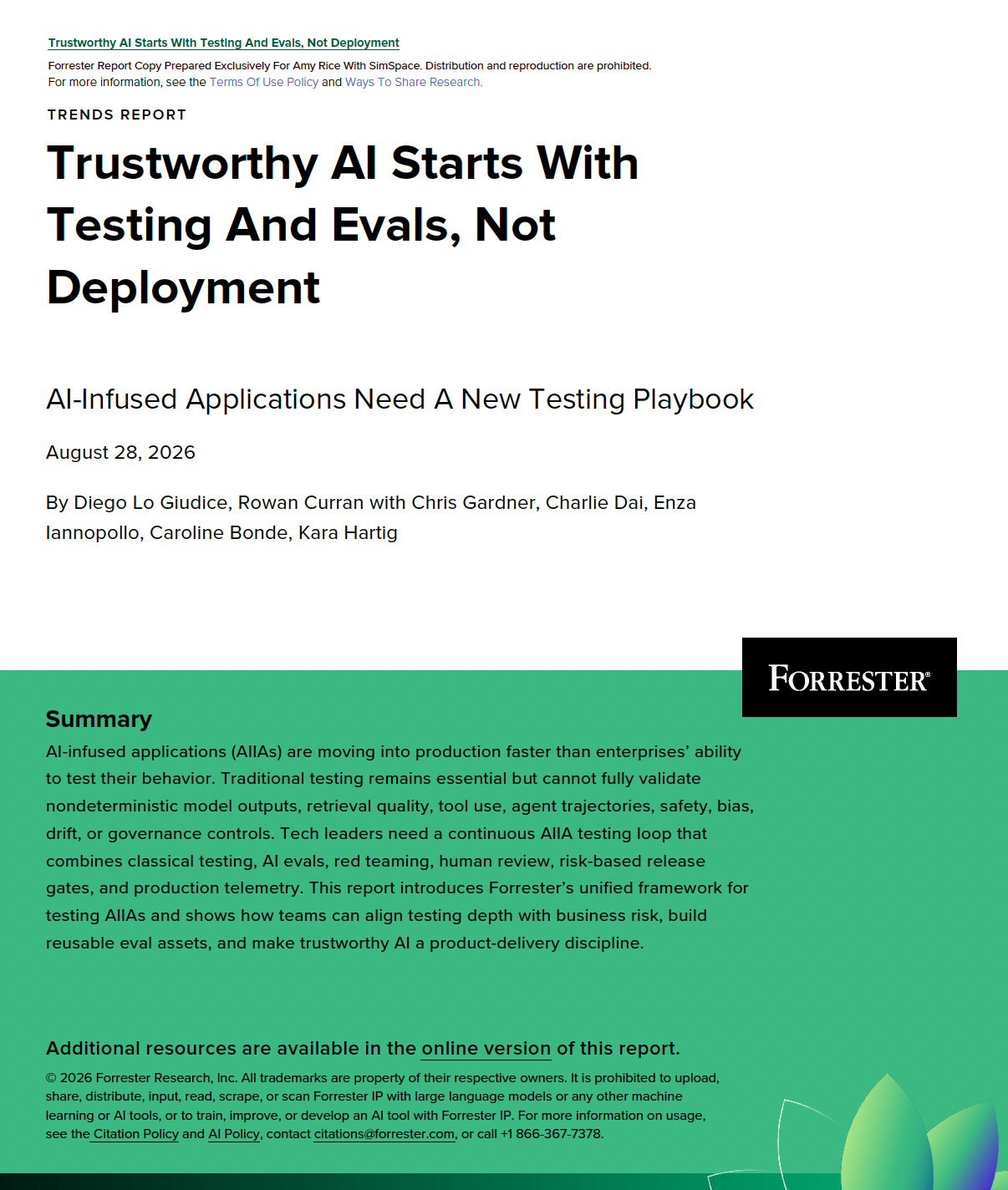
In Forrester’s recent report, “Trustworthy AI Starts With Testing And Evals, Not Deployment” (by Diego Lo Giudice and Rowan Curran, et al.), analysts point to a fundamental shift in software delivery. The consensus is clear: traditional testing practices alone cannot validate non-deterministic systems. Treating production monitoring as a safety net leaves businesses exposed to severe quality, security, brand, and legal liabilities.
SimSpace was cited as a research contributor to this report. Here are the key findings from Forrester’s unified framework and an explanation of how the SimSpace AI Proving Grounds methodology addresses this gap by validating and training AI agents inside high-fidelity enterprise replicas prior to deployment.
The AI Testing Gap: Why Traditional QA and Post-Release Ops Fall Short
For decades, software quality assurance relied on deterministic testing. If an input was provided, code followed pre-set logic to generate an expected output. However, modern AI applications combine predictive logic, foundation models, retrieval-augmented generation (RAG), external tool invocations, and autonomous agent orchestration.
These additions mean AI failures rarely look like traditional software bugs:
- Compounded System Risks: A single foundation model might pass basic accuracy benchmarks in isolation. However, when embedded into a live workflow—where it accesses tools, queries RAG vector databases, and executes actions—system-level vulnerabilities emerge. Forrester cites examples where malicious instructions embedded in context data (such as Google Calendar invites) were interpreted by models, triggering unauthorized downstream actions like data exfiltration or permission bypasses.
- Emergent Agent Behaviors: As applications shift from simple retrieval to agentic execution, failures stem from complex trajectories: improper tool selection, memory contamination, hallucinated parameter passing, and unhandled exceptions across multi-step handoffs.
- The Cost of Post-Release Patching: Relying on production observability and telemetry to catch these issues means real users, sensitive internal data, and business operations act as the testing layer. High-profile failures—like chatbots giving illegal refund guidance or leaking confidential data—prove that post-deployment monitoring is insufficient.
Forrester’s Unified Framework for Testing AI-Infused Applications
To close the testing gap, Forrester outlines a continuous loop that synthesizes classical testing, model evaluations (evals), adversarial red teaming, human oversight, and risk-based release gates.

Key principles highlighted in the report include:
- Risk-Proportional Testing: Testing depth must match business impact and blast radius. Low-risk apps can rely on lightweight evals, but agentic systems with execution authority demand deep behavioral evals, adversarial stress-testing, and strict release gates.
- End-to-End Workflow Validation: Teams must evaluate the complete system harness—models, prompts, permissions, API connections, memory, and UI—rather than judging isolated prompts.
- Adversarial Red Teaming: Probing multi-turn agent interactions against indirect prompt injection, policy evasion, data leakage, and unexpected tool calls.
- Converting Production Learning into Pre-Deployment Assets: Transforming runtime edge cases and failure traces into automated pre-release regression packs.
Bridging the Gap: How SimSpace AI Proving Grounds Fulfill Forrester’s Vision
The core challenge for tech leaders has been finding an environment where AI agents can be stress-tested, red-teamed, and fine-tuned across multi-step trajectories without risking live systems. This is where the SimSpace AI Proving Grounds methodology directly aligns with Forrester’s recommendations.
1. High-Fidelity Enterprise Replicas vs. Static Sandbox Labs
- The Forrester Recommendation: Test the full system context end-to-end—including infrastructure, databases, data permissions, and external tool calls.
- The SimSpace Approach: SimSpace AI Proving Grounds construct realistic replicas of an organization’s network, security stack, data permissions, and tool ecosystems. AI agents operate in an isolated environment that mirrors actual enterprise dynamics, generating realistic telemetry and logs without risking live production environments.
2. Multi-Step Adversarial Red Teaming & Trajectory Testing
- The Forrester Recommendation: Red-team applications against complex, multi-step threat vectors, indirect prompt injections, and improper tool executions.
- The SimSpace Approach: Inside the AI Proving Grounds, autonomous and agentic systems are subjected to automated attack scenarios and live-fire adversary simulations. Teams observe how agents handle real-world pressure, verifying decision quality, policy guardrails, escalation behavior, and tool reliability during multi-stage exploits.
3. Safe Pre-Deployment Training & Fine-Tuning
- The Forrester Recommendation: Establish offline evals and golden datasets as CI/CD quality gates before exposing users to new model capabilities or workflows.
- The SimSpace Approach: By running agents through repeated scenario execution in cloned environments, organizations collect statistically sound behavioral baselines. AI agents can safely fail, learn, and be fine-tuned inside the AI Proving Grounds, giving engineering and security teams empirical proof of reliability before granting agents operational authority.
4. Continuous Feedback Loops for Long-Term Governance
- The Forrester Recommendation: Establish a closed-loop discipline where real-world edge cases continuously expand pre-deployment regression assets.
- The SimSpace Approach: As threat vectors evolve and foundational models update, the AI Proving Grounds allow teams to continuously re-evaluate agent behavior against new threat models. Failure modes discovered under stress are captured, scored, and turned into permanent regression packs for future release decisions.
Moving Beyond Assumptions: The Path to Proven AI Agents
Proof of validated AI agents cannot be established through post-release monitoring or high-level policy statements alone. As Forrester’s research demonstrates, proven AI is a product delivery discipline rooted in empirical validation, risk-tiered testing, and rigorous pre-deployment evals.
By utilizing environments like SimSpace AI Proving Grounds, organizations can shift testing left. By subjecting AI agents to live-fire scenarios, complex workflows, and adversarial conditions inside high-fidelity replicas, technology leaders can deploy agentic capabilities with complete confidence.


