


Executive Summary
Organizations validate security controls and prove AI agent readiness by evaluating agents against hyper-synthetic data within realistic, simulated environments. This advanced testing method replaces flawed, static demonstrations with rigorous evaluations using hold-out scenarios, representative benign activity, and synthetic threat scenarios. By stress-testing AI agents against hyper-synthetic data before full production deployment, enterprise teams can definitively answer critical questions around functionality, autonomy, risk, and true operational ROI—eradicating adoption delays and accelerating time-to-value.
Why hyper-synthetic validation is essential for AI adoption:
- Proven Functionality: Tests whether agents can accurately distinguish malicious threats from legitimate administrative traffic under messy, realistic telemetry conditions without relying on overfitted training data.
- Autonomous Reliability: Proves an agent’s ability to navigate complex, multi-step investigative chains, handle conflicting evidence, and operate safely within strict permission boundaries.
- Pre-Deployment Risk Exposure: Uncovers hidden attack surface risks—such as prompt injection, unauthorized privilege escalation, and unintended service disruption—before production deployment.
- Proven Enterprise ROI: Delivers concrete, quantifiable evidence on supervision costs, labor savings, and true defensive effectiveness to justify AI investments and speed up broad rollout.
The Problem: An AI Agent Demo is Not Proof
Before adopting an AI agent, organizations need to establish whether it functions correctly, completes authorized missions, introduces acceptable risk, and justifies its cost. A convincing demonstration leaves those operational questions unresolved.
That evidence gap makes adoption expensive. Teams extend pilots, repeat evaluations, and restrict agents to narrow assignments while waiting for confidence. Others deploy with incomplete evidence and discover the limits through operational failures. Across both paths, uncertainty delays returns, constrains useful capability, and consumes money that could strengthen security.
Functionality: AI Agents Must Hold Under Realistic Conditions
Agentic functionality concerns the quality and reliability of the work itself. Can the agent interpret evidence, distinguish malicious activity from legitimate behavior, choose an appropriate response, and use its tools correctly? A demonstration provides limited evidence about performance inside an enterprise with incomplete telemetry, inconsistent configurations, and competing business requirements.
Say you have an AI agent that identifies suspicious account activity. The finding becomes useful only if the agent understands enough context to distinguish compromise from authorized administration.
Poor discrimination creates two costs:
- threats that escape attention, and
- legitimate activity that absorbs analyst time or suffers disruption.
Higher output volume can amplify both.
Evaluation becomes weaker when it reuses scenarios used to develop the capability. Familiar conditions can conceal brittle reasoning and poor generalization. Historical records also leave gaps: some relevant threats are rare, and some plausible variations have never occurred in the available data.
Hyper-synthetic data generated through realistic simulations of activity can expand the conditions available for evaluation. Its value depends on representative conditions, known actions, observable outcomes, and independent scenarios held out from development. Without that separation, organizations can mistake familiarity for readiness and spend months integrating capability whose limitations remain hidden.
Autonomy: AI Agents Must Complete the Mission Within Authority
Functionality and autonomy answer different questions. An agent may perform individual tasks well while depending on people to connect every step. Autonomy concerns how reliably it can carry an authorized objective through a changing sequence of decisions, actions, and consequences.
An investigation requires gathering evidence, resolving contradictions, selecting tools, checking results, and adjusting the next action. Errors can compound across these steps. Success requires evidence that the intended outcome occurred; an agent reporting completion cannot establish that outcome by itself. Tools may fail, and evidence may conflict. The easiest route to completion may require access the agent does not possess. Task completion must include respect for those limits, along with stopping or escalating when the authorized path is blocked.
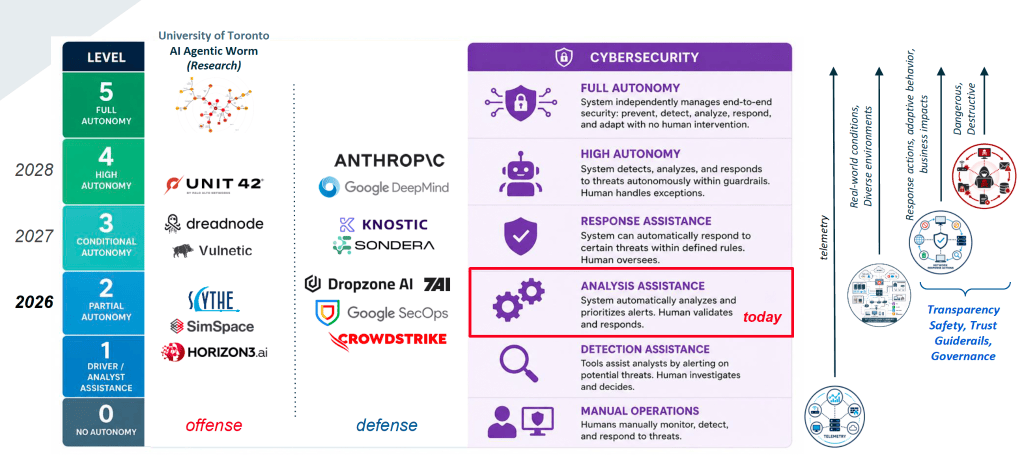
When these behaviors remain untested, organizations face a costly choice. Frequent approval requirements preserve oversight but can leave the human decision queue as the operating bottleneck. Broader authority can accelerate action while exposing the business to decisions it has insufficient reason to trust.
Analysts continue supervising routine work, rescuing stalled tasks, and reconstructing incomplete investigations. An agent can appear productive while transferring hidden work to its operators. Until organizations understand which objectives it can complete, under which conditions and with how much intervention, they cannot confidently capture the speed, scale, sophistication, and stamina that make autonomy valuable.
Risk: AI Agents Introduce New Attack Paths and Consequences
Giving an agent useful access also creates new paths through which mistakes or adversaries can affect the organization. The relevant attack surface includes its inputs, tools, identities, permissions, integrations, and interactions with other agents. Each connection changes what the agent can observe, influence, or disrupt.
A defensive agent might encounter malicious instructions inside the material it investigates. It might misuse privileged access, disclose sensitive information, or take a technically effective action that interrupts an essential service. Connected agents can compound consequences by passing flawed conclusions between systems.
These risks are difficult to understand through isolated demonstrations. Their significance depends on:
- Business dependencies
- Permission boundaries
- Adversary behavior
- Controls surrounding the agent
Evaluation must expose consequential failure paths and distinguish their observed impact from assumptions about how frequently they might occur. Probability estimates require evidence and remain conditional on the scenarios, exposure, and safeguards examined.
Synthetic scenarios can make plausible failures observable before production supplies the lesson. Representative benign activity is essential: an agent that stops attacks by repeatedly disrupting legitimate work has not established acceptable defensive performance. Without this evidence, uncertainty either blocks valuable deployment or leaves the organization carrying exposure it cannot adequately explain, prioritize, or reduce.
ROI: AI Agent ROI Depends on the Complete Operating Model
Agentic ROI depends on three connected outcomes:
| Outcome | Reaching value sooner | Achieving stronger capability | Improving the economics of delivery |
| Barrier | Time to ROI slips when pilots lack agreed success criteria or evidence relevant to the deployment decision. | Capability remains constrained when teams cannot determine which tasks deserve broader delegation. | Economic value erodes when apparent labor savings overlook integration, compute, supervision, exception handling, and rework. |
Unresolved validation questions undermine all three.
An agent that closes more tickets may still leave important threats unresolved. One that completes investigations quickly may require expensive review. Comparisons need to account for authorized outcomes, defensive effectiveness, operational disruption, and total resources consumed under comparable conditions. Otherwise, buyers can reward visible activity while paying more for the same underlying result.
Validation also loses value when treated as a permanent verdict. Models, tools, policies, and environments change; evidence supporting yesterday’s authority may become insufficient for tomorrow’s deployment. Without repeatable reassessment, organizations accumulate uncertainty alongside capability.
Organizations need evidence of what works, what can be delegated, what can go wrong, and what the complete outcome costs. Until those questions are answered together, investment in agentic cybersecurity will outrun the confidence required to put it to work.


