

Next-generation frontier models—like Anthropic’s Claude Mythos and OpenAI’s Daybreak—have permanently shifted the dynamics of cybersecurity. Attackers no longer spend weeks hand-crafting exploit payloads; instead, model-driven attack chains map networks, discover zero-days, and execute multi-stage living-off-the-land (LoTL) tactics in seconds.
To survive this machine-speed threat landscape, virtually every cybersecurity vendor is pitching autonomous AI agents as a silver bullet. However, beneath the marketing polish lies a stark reality: According to the State of Agentic Cybersecurity Report, while 73% of security leaders have deployed AI agents into their SOC workflows, only 27% express maximum confidence in them.
Bridging the gap between deployment and trust requires moving away from point-in-time purchasing checks and embracing continuous, empirical stress-testing within dedicated AI Proving Grounds.
The Four Operational Realities Facing Security Leaders
When evaluating AI agents, CISOs and security operation leaders face four blunt operational problems:
- Time: You cannot afford 30-day patch windows or 6-hour triage loops when adversary breakout time drops to minutes. Security teams need AI tools that compress time-to-value without adding operational drag.
- Optimal Capability: Sterile vendor demos rarely reflect real-world performance. Without empirical testing, you cannot predict whether an agent will perform at its mathematical limit or hallucinate and disrupt production when exposed to a messy, multi-cloud enterprise environment.
- Cost Savings: Security leaders are under immense pressure to expand SOC capacity without ballooning headcounts. Yet, onboarding unvalidated AI tools often introduces an initial 10–20% performance dip that drains team efficiency.
- Trust: Granting autonomous execution permissions to non-deterministic software carries extreme risk, especially when model error rates hover near 60% on complex reasoning tasks.
Unlike traditional security tools that fail deterministically (a firewall rule either permits or blocks traffic), Large Language Models (LLMs) fail non-deterministically. They suffer from context blindness—such as an agent recommending an enterprise-wide block on Microsoft Excel because of a malicious macro—as well as prompt injection vulnerabilities and unsupervised model drift over time.
Phase 1 vs. Phase 2: Solving “Consent Fatigue”
To deploy AI responsibly, security leaders must recognize where the market is today versus where R&D is heading:
- Phase 1 (Current Production State – Level 2 Autonomy): AI agents excel at automated alert triage, context enrichment, and root-cause investigation. However, because full trust has not been established, organizations enforce strict human-in-the-loop approval gates for every response action. This has shifted SOC analysts from Alert Fatigue to Consent Fatigue. Reviewing and approving every proposed action turns human operators into the rate-limiting step, neutralizing the advantage of machine speed.
- Phase 2 (Future / R&D Horizon – Level 3+ Autonomy): This phase enables true autonomous response and playbook execution. Moving safely from Phase 1 to Phase 2 requires a risk-free environment where AI agents can prove their decision logic against live adversary behavior before receiving execution authority.
The Three-Pillar AI Proving Grounds Framework
The SimSpace AI Proving Grounds framework provides the structure needed to overcome these operational barriers across both current and future operational phases.
| Validate AI Agents | Operationalize AI Agents & Human Operators Together | Build AI Agents |
| Audit boundaries in a zero-risk digital replica of the production environment. | Refine handshakes and eliminate consent fatigue in production. | Eliminate static data flaws and build models on live attack streams. |
1. Validate AI Agents Through Continuous Stress-Testing
Before granting an agent production access, security teams can host the agent stack directly inside a digital replica of their multi-cloud topology. By running continuous attack loops—featuring Mythos- and Daybreak-style exploits, lateral movement, and indirect prompt injection attempts—teams can audit decision accuracy and verify policy guardrails under heavy event load without risking live production assets.
2. Operationalize Humans and AI Together
Handoffs between AI agents and human analysts are a frequent source of friction and context loss. Placing human operators and AI agents side-by-side in live-fire cyber simulations enables teams to rehearse hybrid SecOps playbooks. Deliberately injecting data tampering and prompt injection scenarios tests analyst override procedures, builds operator trust, and flattens decision timelines.
3. Build AI Agents with Hyper-Synthetic Data
Training models on static, public threat feeds leads to high false-positive rates and model drift, while privacy rules prevent training on actual customer data. SimSpace partners with AI builders and hyperscalers to launch targeted nation-state and e-crime attack campaigns (mapped to MITRE ATT&CK) inside isolated, mirrored network ranges. Harvesting this multi-vector log telemetry creates hyper-synthetic, precision-labeled training data that hardens agent logic before models ever touch customer networks.
Measuring Readiness: The Defensive Security Readiness (DSR) Curve
Systematic evaluation using the Defensive Security Readiness (DSR) index demonstrates that integrating AI into the SOC follows a learning curve rather than providing an instantaneous fix.
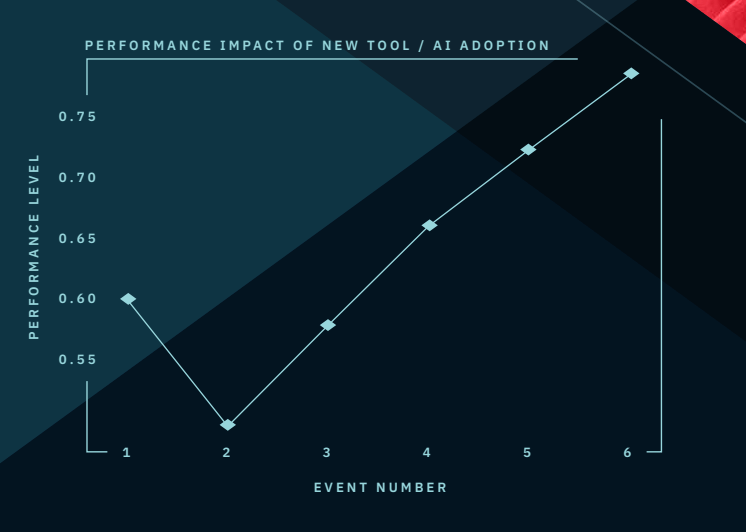
- Overcoming the Adoption Dip: Onboarding new AI tools initially causes a 10–20% drop in operational readiness due to alert noise and analyst hesitation. Iterative range testing recovers this performance gap without exposing live systems to risk.
- Measurable Progress: Teams engaging in frequent range exercises improve their DSR score by 0.03–0.05 per event, reaching mature capability levels (0.70–0.80+) within 4 to 6 iterations.
- Closing the Execution Gap: Joint human-AI rehearsals yield a 15–40% improvement in operational response precision, resolving handoff bottlenecks.
Read the full State of Agentic Cybersecurity Report >
Strategic Governance: Legacy vs. Mythos-Ready SOC
| Capability Dimension | Legacy SOC Approach | Phase 1 Agentic SOC (Current State) | Phase 2 Mythos-Ready SOC (Target) |
| Primary Scope | Manual alert triage & playbook execution | AI-driven triage with human approval gates | Automated triage, investigation, & validated autonomous response |
| Operational Bottleneck | Alert Fatigue | Consent Fatigue (Human approval required) | None (Proven execution within policy guardrails) |
| Validation Cadence | Annual tabletop exercises / quarterly audits | Ad-hoc testing during tool procurement | Continuous live-fire simulations in digital replicas |
| Training Sourcing | Public threat feeds & static customer logs | Public threat feeds & static customer logs | Precision-labeled, hyper-synthetic log telemetry |
Action Items for Security Leaders
To move beyond the vendor hype and prepare your SOC for machine-speed threats, focus on three immediate initiatives:
- Optimize Triage Today: Address the bottleneck of consent fatigue by refining analyst-agent approval workflows inside replica environments.
- Demand Synthetic Validation: Require AI vendors to show empirical proof of model training and validation using hyper-synthetic, full-stack attack data before granting production access.
- Establish an AI Proving Ground: Transition from one-off tool pilots to continuous, live-fire rehearsals that measure joint human-agent performance via objective DSR metrics.


