
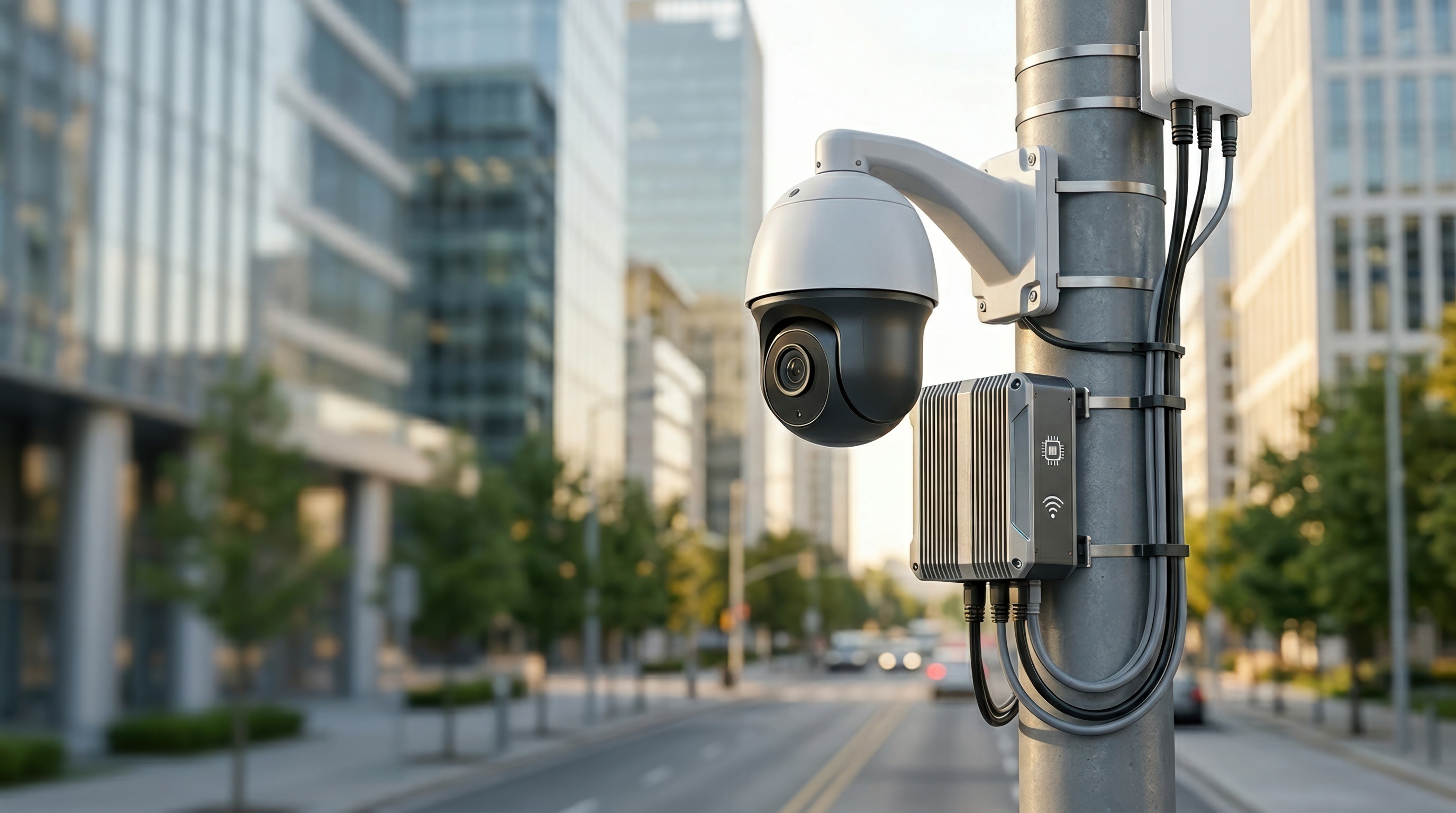
As artificial intelligence expands from pure data analysis into physical interaction, Spatial AI has emerged as a cornerstone of modern infrastructure. Spatial AI systems rely on computer vision feeds, IP cameras, LiDAR, and edge perception networks to build continuous spatial awareness. From monitoring physical perimeters to guiding autonomous systems and critical infrastructure, these visual sensors serve as the digital eyes of the physical world.
However, this reliance creates a dangerous vulnerability. Internet-facing IP cameras and edge perception hardware are increasingly targeted by advanced threat actors. When adversaries compromise these devices, they are not merely seeking network access—they are weaponizing spatial data to enable physical outcomes.
To protect Spatial AI ecosystems, security teams must look beyond traditional network security and adopt active Early Warning Indicators (EWIs) that detect device compromise at the behavioral level before physical integrity is lost.
Edge Devices as Pre-Kinetic Sensors
Enterprise security teams frequently dismiss edge cameras as low-priority operational noise. In reality, nation-state adversaries view compromised edge devices as pre-kinetic sensors for physical operations.
A real-world illustration of this threat was documented by Check Point Research regarding an Iranian campaign targeting exposed IP cameras across seven nations. Adversaries systematically exploited vulnerabilities across camera vendors (such as Hikvision and Dahua) to hijack live video feeds. These compromised feeds were leveraged for physical military support, including reconnaissance, missile targeting correction, and battle damage assessment—including an instance where a commandeered street camera faced a research institute shortly before a strike.
| The Pre-Kinetic Attack Lifecycle | |
| Phase 1: Pre-Kinetic Probing Scanning, CVE Exploitation & Default Credential Probing Defensive Signal: EWI catches latency & payload anomalies via ML |
↓
| Phase 2: Live Reconnaissance Feed Hijacking, Real-Time Object Tracking & Target Acquisition Preemptive Window: Lead time to isolate the device and block the adversary |
↓
| Phase 3: Kinetic Engagement Physical Strikes, Guidance Correction, Battle Damage Assessment Physical Impact: Physical damage or critical facility outage |
When Spatial AI systems depend on the integrity of visual streams, a compromised sensor compromises the entire decision chain. If an adversary alters, delays, or feeds false spatial data into an AI-driven management platform, the physical consequences can be immediate.
Detecting Compromise via Behavioral Vitals
Protecting Spatial AI sensors presents unique technical challenges. Cameras and edge perception nodes frequently run light, proprietary firmware, communicate over encrypted channels, or sit on out-of-band networks where traditional inline packet inspection cannot reach. Furthermore, static signature updates cannot keep pace with zero-day exploit payloads designed to bypass standard firewalls.
Rather than attempting to inspect encrypted payload contents, defenders must monitor the hardware’s internal “vitals”.
When an attacker executes an exploit chain on an edge device—such as unauthenticated configuration extraction, authentication bypass, or remote code execution (RCE)—the underlying CPU experiences measurable operational overhead. An active-probing engine, such as an EWI Radar managed in a cyber range periodically issues lightweight queries to edge devices, tracking two primary metrics:
- Response Latency (ms): Measures the CPU processing overhead induced on the device as it handles concurrent, unauthorized malicious background tasks.
- Response Size (bytes): Identifies anomalous endpoint targeting and payload variations resulting from unauthorized access or data exfiltration attempts.
By focusing on physical hardware stress rather than traffic signatures, active behavioral monitoring identifies compromise regardless of the exploit mechanism or network path.
Preserving Spatial Awareness with Explainable AI
In an automated or semi-automated Spatial AI deployment, false alarms can be almost as disruptive as real intrusions. Disconnecting an IP camera cluster every time network latency blips occur can blind physical monitoring systems and disrupt autonomous workflows.
To solve this, behavioral detection systems must provide Explainable AI (XAI) that distinguishes normal operational noise (like routine maintenance or high-volume user access) from genuine malicious activity.
EWI Radar accomplishes this by running an unsupervised Isolation Forest alongside a deterministic backstop, then feeding alerts into a multi-factor corroboration engine. This engine evaluates additive threat signals, including:
- Known Threat Infrastructure: Cross-referencing traffic sources against threat-attributed IP blocks and CIDR ranges.
- Multi-Device Progression: Tracking whether anomalous behavior is escalating across multiple devices in a rolling window, a pattern indicative of coordinated reconnaissance.
- Sustained Anomalies: Verifying that a device displays anomalous latency over multiple consecutive polling cycles to rule out transient blips.
- Time-Window Matches: Correlating activity against historical operational patterns.
These signals synthesize into a transparent Threat Confidence Score (rated Low, Elevated, High, or Critical). When a Spatial AI system receives a “Critical” EWI alert, security teams receive an explicit, plain-language rationale:
“Latency is elevated relative to baseline and confirmed by both detection mechanisms; activity correlates with known threat infrastructure across multiple devices. Classified ANOMALOUS.”
Securing the Digital-Physical Frontier
As Spatial AI becomes deeply integrated into smart cities, defense facilities, and critical infrastructure, physical security and cybersecurity can no longer be managed in silos. Edge cameras and perception sensors are the frontline sensors of both realms.
By deploying active, behavioral Early Warning Indicators, organizations can identify pre-kinetic probing in Phase 1 of an attack. This provides security operators with the actionable lead time necessary to isolate compromised hardware, protect spatial perception feeds, and prevent digital intrusions from turning into physical incidents.
The Cyber Range as an AI Proving Ground for Early Warning Indicators
A cyber range serves as a controlled environment where machine learning algorithms can confront real-world adversarial behavior without placing production environments at risk. Moving a detector from a theoretical algorithm to a production-ready defensive capability on a range follows a precise, five-phase proving cycle:
- Digital Twin Emulation: Defenders build high-fidelity digital twins of physical edge fleets, replicating specific hardware models (such as Hikvision and Dahua IP cameras), authentic firmware interfaces, and real TLS certificates.
- Synthetic Telemetry Baselining: Legitimate administrative and user traffic loops are injected into the environment, establishing a clean, statistically valid operational baseline.
- Live Adversary Campaign Injection: Multi-stage attack scripts—built directly from documented adversary tradecraft—are launched against the simulated fleet.
- AI Model Training & Validation: Unsupervised machine learning models run against the combined traffic, proving their ability to isolate threat activity.
- Defect Elimination: Range operators analyze false-positive spikes, root-cause mathematical boundary errors, and refine detection logic.