
The traditional software engineering lifecycle is breaking under the weight of autonomous AI agents.
According to the Gartner® Hype Cycle™ for Chief Product Officers, 2026, “The 2025 Gartner Chief Product Officer Survey found that only 26% of CPOs could express strong confidence in their organization’s preparedness given the accelerating pace of change driven by AI.” Furthermore, while CPOs anticipate that 56% of revenue growth will come from AI products, traditional product management tactics are failing to deliver.
For decades, Chief Product Officers relied on post-launch product analytics—tracking drop-off rates, telemetry, and user friction weeks after a release—to iterate on software. But when building non-deterministic AI agents, waiting for telemetry after deployment is a catastrophic strategy. A hallucinated action or an edge-case integration failure in production doesn’t just cost a user click; it can wipe out customer trust, leak sensitive data, or break critical infrastructure.
To win in the AI vendor race, forward-thinking product organizations are replacing lagging post-launch analytics with preemptive simulation, leveraging Hyper-Synthetic Data (HSD) and isolated digital ranges to validate AI models before code ever reaches a live customer.
The Shift: The “Train-Augment-Validate” Pipeline
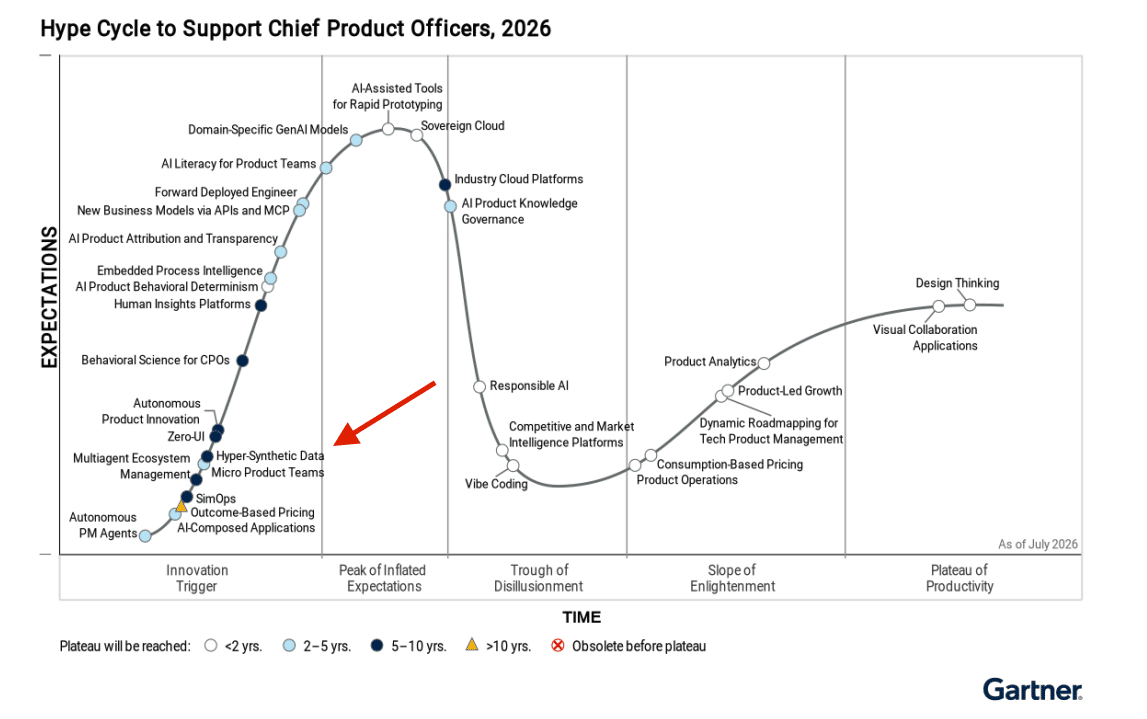
In the 2026 CPO Hype Cycle, Gartner positions Hyper-Synthetic Data in the Innovation Trigger phase with a High Benefit Rating, noting that “Real-world data is often biased, incomplete, limited to past events and constrained by data privacy laws. Hyper-synthetic data overcomes these constraints by modeling what could be rather than just what is, and it does so economically and at scale.”
This shift is underscored in Gartner’s report, Emerging Tech: Hyper-Synthetic Data Is Essential to Winning the Future of Cybersecurity, where SimSpace is highlighted for its role in enabling high-fidelity simulation environments. As Gartner research demonstrates, testing unproven autonomous agents in live systems poses severe risks. HSD provides a safe, scalable “proving ground” that allows organizations to move from reactive defenses to preemptive validation against novel, never-before-seen threat vectors and edge scenarios.
To harness this power, CPOs are implementing a three-stage engineering loop designed to manage agentic unpredictability:
- Train: Pre-train models on clean, compliant baseline enterprise data.
- Augment: Fill data scarcity gaps, rare user paths, and complex threat profiles using hyper-synthetic simulation. As Gartner notes, HSD unlocks massive opportunities where real data is scarce, highly regulated (GDPR, HIPAA), or dangerous to collect.
- Validate: Stress-test agent reliability in live-fire, isolated environments (sandboxes) before enterprise deployment.
As Clint Sand, Chief Product Officer at SimSpace, noted during a recent discussion on agent validation:
“When AI exploded, our testing-focused, high-realism ranges became a natural fit for building and testing AI agents… security vendors are coming to us to help build and test their agents in ways their buyers will trust.”
Solving the Realism Gap: “Brain vs. Body”
Why do AI agents that look brilliant in development benchmarks fail when deployed to enterprise environments? They suffer from a lack of environmental realism.
An AI model represents the “brain,” but the target system—complete with API noise, user behavior emulation, concurrent software traffic, and unexpected edge cases—represents the “body”. Gartner highlights that new operational paradigms like SimOps (positioned in the Innovation Trigger with a Transformational benefit rating) leverage simulation and real-time feedback loops to establish “a navigation-like experience and drive greater autonomy”, allowing machines to simulate and adapt solutions before execution.
Without this contextual fidelity, models break the moment they interact with complex enterprise workflows.
“We’ve built both the brain and the body… environmental realism is the key differentiator,” explains Sand. “You need context-specific knowledge that can’t be easily replicated.”
The Brain vs. Body Architecture in Preemptive Simulation
| System Component | Role | Function in Simulation | Relevant Gartner Innovation |
| “The Brain” | AI Model & Agent Logic | Processes tasks, generates responses, and makes autonomous decisions. | Domain-Specific GenAI Models |
| “The Body” | Target System & Environment | Emulates full operational realism, including API traffic, user actions, and noise. | SimOps & Composable Architectures |
| Hyper-Synthetic Data (HSD) | Context & Stress Vectors | Injects rare edge cases, threat vectors, and synthetic personas into the testing loop. | Hyper-Synthetic Data |
| Feedback Loop | Continuous Validation | Measures agent behavior against the environment to establish predictability. | AI Product Behavioral Determinism |
By combining attack simulation and automated user emulation, platforms like SimSpace’s AI Proving Grounds give product teams the ability to run hundreds of varied scenario runs. This exposes integration points and system edge cases from day one of development, rather than day ninety of a live pilot.
Taming the Probabilistic Nature of AI: Behavioral Determinism & Cost Control
A primary barrier to enterprise AI adoption is unpredictability. Gartner includes AI Product Behavioral Determinism in the 2026 Hype Cycle (High Benefit), warning that “Without the enforcement of such measures, CPOs face unpredictable and unreliable AI behavior. These random behaviors lead to negative business implications, customer churn, stalled adoption, regulatory breaches and safety hazards.”
Preemptive simulation gives product leaders the sandbox needed to establish behavioral guardrails and evaluate AI Product Attribution and Transparency—linking every autonomous action back to verifiable data sources and reasoning steps.
Furthermore, simulation environments help CPOs solve the growing CFO crisis around runaway AI infrastructure spend. By testing workloads in a simulated Proving Ground, product teams can implement Inference Tiering—testing where low-cost, domain-specific models can handle commodity tasks versus where expensive frontier LLMs are genuinely required.
Go-To-Market Acceleration & Third-Party Trust
Shifting to a simulation-first strategy does more than fix software bugs; it fundamentally accelerates Go-To-Market dynamics through Product-Led Growth (PLG).
- Safe Customer Proof-of-Concepts: Gartner notes that CPOs can use HSD to “build real-world test beds for net-new product concepts… letting prospects trial a platform with HSD extensions of their own small samples without sharing confidential data.”
- Third-Party Validation: B2B buyers are deeply skeptical of unverified vendor AI claims. Answering “who watches the watcher” requires third-party proof that an agent has undergone rigorous, independent stress-testing.
“Our go-to-market is to win the builders first, then move to buyers of agents,” Sand emphasized. “Third-party validation—answering ‘who watches the watcher’—is inherently valuable to enterprise buyers.”
The CPO Action Plan
For product leaders building the AI-driven organization of tomorrow:
- Adopt a “Train-Augment-Validate” Pipeline: Stop relying solely on incomplete historical datasets. Leverage Hyper-Synthetic Data to simulate edge cases, system spikes, and rare operational failures before design freeze.
- Build for Behavioral Determinism: Establish controlled environments to simulate scenarios for evaluating agents in preproduction. Mandate structured attribution trails so every agent action is traceable and auditable.
- Optimize Model Economics via Dynamic Routing: Use simulation environments to benchmark task complexity. Route standard tasks to lower-cost, domain-specific models to protect margins as usage scales.
- Leverage AI Proving Grounds for Third-Party Trust: Differentiate your AI product by providing buyers with third-party, verified testing data from high-realism cyber simulations in AI Proving Grounds.
To learn more about the use of Hyper-Synthetic Data for the modern CPO, get a complementary copy of Gartner’s Emerging Tech: Hyper-Synthetic Data Is Essential to Winning the Future of Cybersecurity.