The cybersecurity landscape has reached an irreversible inflection point. As artificial intelligence transforms from a passive administrative tool into autonomous, goal-oriented infrastructure, cybersecurity leaders face an asymmetric threat environment that traditional, and even proactive defenses are ill-equipped to handle. To chart a path forward, the newly formed AI Proving Grounds Consortium brought together world-class security leaders for a vital virtual event titled “Move From Proactive Defense to Preemptive Resilience.”
The mission of the event was clear: lay down the blueprint for building deep trust in AI defenses while out-innovating an increasingly sophisticated adversary. For organizations navigating the shift to autonomous security operations, here are the essential lessons and structural takeaways from the consortium’s front-line experts.
1. AI is the New Uranium: A Paradigm Shift in Threat Velocity
In his opening keynote, renowned ethical hacker and social engineer Freaky Clown (FC), co-founder of Cygenta, challenged the industry’s comforting cliché that “data is the new oil.” Instead, FC asserted that AI is more accurately analogized to uranium: a technology of devastating power that demands intensive procedural governance and environments explicitly engineered to fail safely.
We are no longer standing on the precipice of AI-enabled warfare—we are actively inside it. What FC calls the “diffusion of knowledge” means that any adversary can now take open-source models and fine-tune them to target specific industries, sectors, or network topologies. This has structurally inverted the physics of cyber attacks. Where a highly skilled human attacker once spent several days focusing on a single target, an operator leveraging AI can now strike multiple organizations simultaneously within a single afternoon.
Because machines can attack at speeds that completely outpace human observation, piling on more raw logs is no longer a viable defensive strategy. As FC warned, excessive logging leads directly to analyst burnout, fatigue, and overwhelming complexity without clarity. The playing field must be leveled by moving away from red tape and adopting the same rapid iteration cycles that attackers use.
2. The Threat Vector: The Anatomy of an Agentic Worm
To anchor the panel’s discussion, Peter Lee, CEO of SimSpace, introduced a chilling technical reality modeled by researchers at the University of Toronto: the Agentic Worm. While traditional polymorphic malware has existed for years, agentic worms represent a fundamentally separate and devastating class of cybersecurity threat.
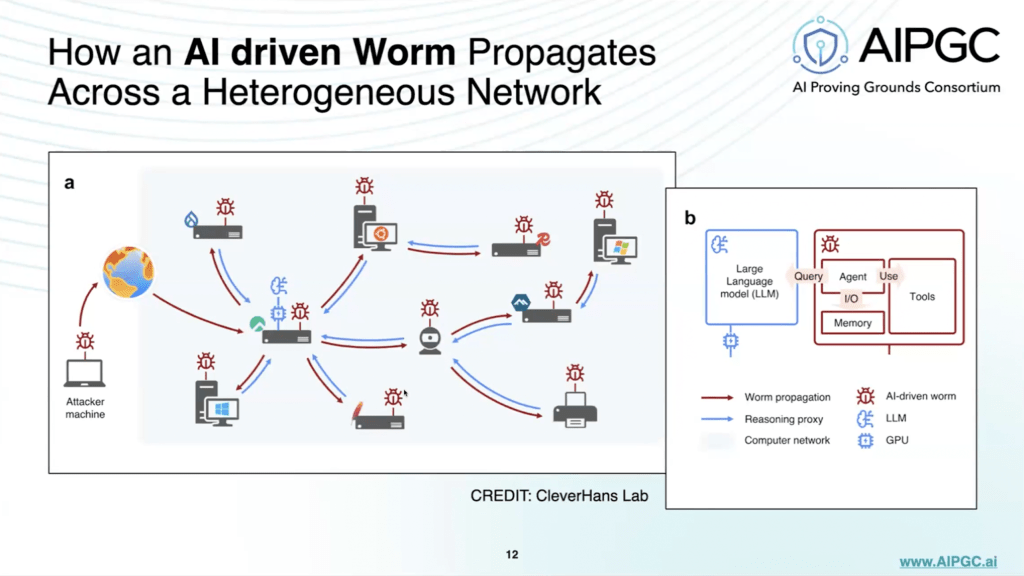
Consider the infamous 2017 Wannacry worm, which disrupted critical infrastructure across 150 countries. Wannacry relied on exploiting a single vulnerability and could be decisively stopped by patching that specific flaw. An agentic worm cannot be stopped this way. It operates inside a recursive reasoning loop, enabling it to autonomously digest exposed information at each stage of a breach and devise entirely novel, target-specific propagation strategies.
Furthermore, the agentic worm does not need to communicate back with a command-and-control (C2) server or the attacker who launched it. Instead, every compromised machine is absorbed directly into the worm’s own infrastructure, providing both the compute power and the intelligence for its next pivot. When an adversary can reason its way through an environment at machine speed, traditional human-paced alert triage queues completely collapse under the sheer volume of concurrent, correlated signals firing across endpoints, networks, and cloud environments simultaneously.
3. The Fuel for Defense: Hyper-Synthetic Data & Simulation
How do you train automated defensive models to recognize and intercept an adaptive, reasoning adversary before it wreaks havoc on production infrastructure? The consensus among the consortium was unanimous: hyper-synthetic data and rigorous simulation are the ultimate prerequisites for success.
Greg Bell, Co-Founder and Chief Strategy Officer of Corelight, detailed an inconvenient truth holding back modern defensive AI: inference limits are fundamentally bounded by data deficiencies. Even though modern large language models are becoming objectively better, more autonomous, and less prone to hallucinations, the security datasets feeding them remain dangerously flawed. Bell outlined two primary ways that data routinely fails defensive AI training:
- Low Resolution: Traditional security data is often too low-resolution—akin to a fuzzy, pixelated image when the AI requires a sharp, high-definition snapshot of real-time network states.
- A Lack of Real-World Realism: Synthetic data is frequently over-simplified and idealized. In reality, corporate environments are incredibly complex, erratic, and full of strange architectural anomalies that standard data models fail to capture.
Because extracting live, real-world data from a production environment is fraught with privacy risks and regulatory hurdles due to sensitive customer information, the solution lies in generating high-resolution, hyper-synthetic data derived from comprehensive emulations. Training defensive models inside a digital replica allows organizations to safely feed a combinatorial matrix of realistic user traffic and advanced attack scenarios to their agents. Without this high-resolution training foundation, automated security tools will trigger catastrophic rates of false positives, ultimately exhausting human analysts and destroying institutional trust in AI defense systems.
As FC summarized, true trust is earned through simulation. Organizations must leverage AI Proving Grounds—a digital replica of their exact production environment—to stress-test defensive and offensive capabilities millions of times over until they are proficient. Security teams will never rise to the occasion of a machine-speed breach; they will fall back to their training.
4. Flipping the Script: AI-Powered Offensive Emulation
Proactive resilience requires not just defending at machine scale, but actively using the adversary’s own tools to find organizational blind spots before they do. Marc Brown, VP of Product and Sales at Scythe, highlighted that AI is structurally shifting how offensive security testing is executed. Historically, advanced threat emulation was restricted to highly specialized red teams. Today, AI enables organizations to ingest Cyber Threat Intelligence (CTI), automatically generate complex threat scenarios, and fine-tune emulations in mere minutes rather than the 40 to 50 hours it used to take.
More importantly, Brown pointed out that defenders can turn the concept of the agentic worm completely on its head. By embedding AI directly into defensive testing implants, security teams can deploy their own “proactive worms.” Instead of running static scripts, these intelligent implants use AI to reason through the live environment they encounter, actively hunting for undiscovered exposures, documenting weaknesses, and verifying that security controls are actually working as expected. This shift allows organizations to continuously patch and validate their defenses long before an actual adversary arrives.
5. Balancing the Control Plane and Operational Economics
Moving defensive models to machine-speed execution presents immediate governance and budgetary challenges. Patrick Duffy, Director of Product at DropZone AI, emphasized that agentic attackers necessitate agentic defenders capable of operating at the exact same tempo. DropZone’s approach relies on pre-triage autonomous agents that run continuous evidence gathering and context-aware investigations in parallel. Instead of forcing a human analyst to start from scratch on an alert count, the AI delivers a completed, evidence-backed work product, converting the human’s role from an alert triage worker into a high-leverage strategic controller.
However, letting loose autonomous agents inside a production network requires an explicit control plane.
Josh Devon, Co-Founder and CEO of Sondera, introduced the vital concept of auto-formalization. Instead of relying on “prompt and pray” natural language instructions, Sondera’s framework converts natural language guardrails into deterministic policy-as-code. This enforces provable boundaries and distinct rules across different business units, allowing organizations to safely transition from human-in-the-loop to human-on-the-loop orchestrators who can confidently audit precisely who, or what agent, took action.
Finally, the panel addressed the rising reality of AI economics. Corporate leaders are experiencing sudden “sticker shock” from ballooning API token expenditures. To counter this, Eric Clopper, Director of Cyber Operations and Effects for MITRE, noted that while we currently rely heavily on cloud-hosted frontier models, the industry will map a heavy structural shift toward local implementations. The panel agreed that running smaller, highly specialized language models (SLMs) locally on edge hardware or via intelligent gateways that route traffic dynamically based on contextual queries will keep computational costs lean while maintaining elite defensive capabilities.
The Path Forward: Train, Validate, Operationalize
As the council concluded, the collective takeaway for enterprise defense was absolute: we must stop treating AI as a magic bullet and start operationalizing it as augmented intelligence designed to empower—not replace—human experience.
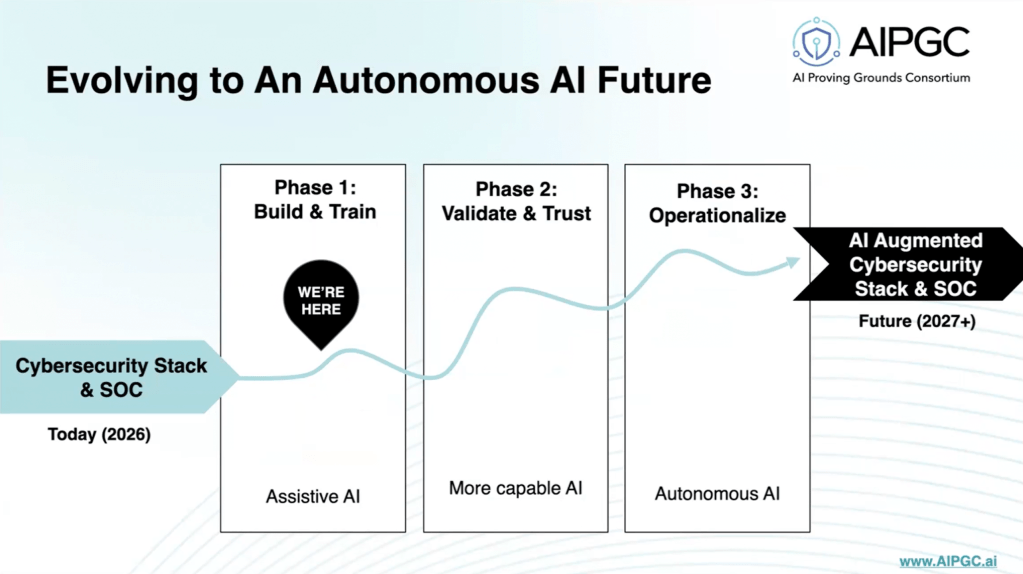
Achieving this requires three immediate structural changes:
- Standardize Common Metrics: Collaborating with standard-setting organizations like MITRE to evaluate autonomous agents based on actual cyber outcomes (detection speed, mitigation effectiveness, and resistance to deception) rather than vendor hype.
- Shift to Continuous Validation: Moving away from expensive, infrequent, point-in-time penetration testing and embracing continuous behavioral validation and “assumed breach” testing via platforms like Scythe.
- Build the AI Proving Grounds: Committing to the development of robust simulation environments to fine-tune your specific network defenses before the next wave of autonomous attacks strikes.
As FC left the audience reminding us of a timeless truth: “There is no fate but what we make.” The technology to defend our networks at machine scale is here; the choice to step out of the reactive log loop and into preemptive resilience belongs to us.
The AI Proving Grounds Consortium is dedicated to helping organizations build trusted autonomy across the C-suite, architecture, and security operations teams. Don’t miss our next virtual event on July 29th, featuring Allie Mellen, Principal Analyst at Forrester Research.