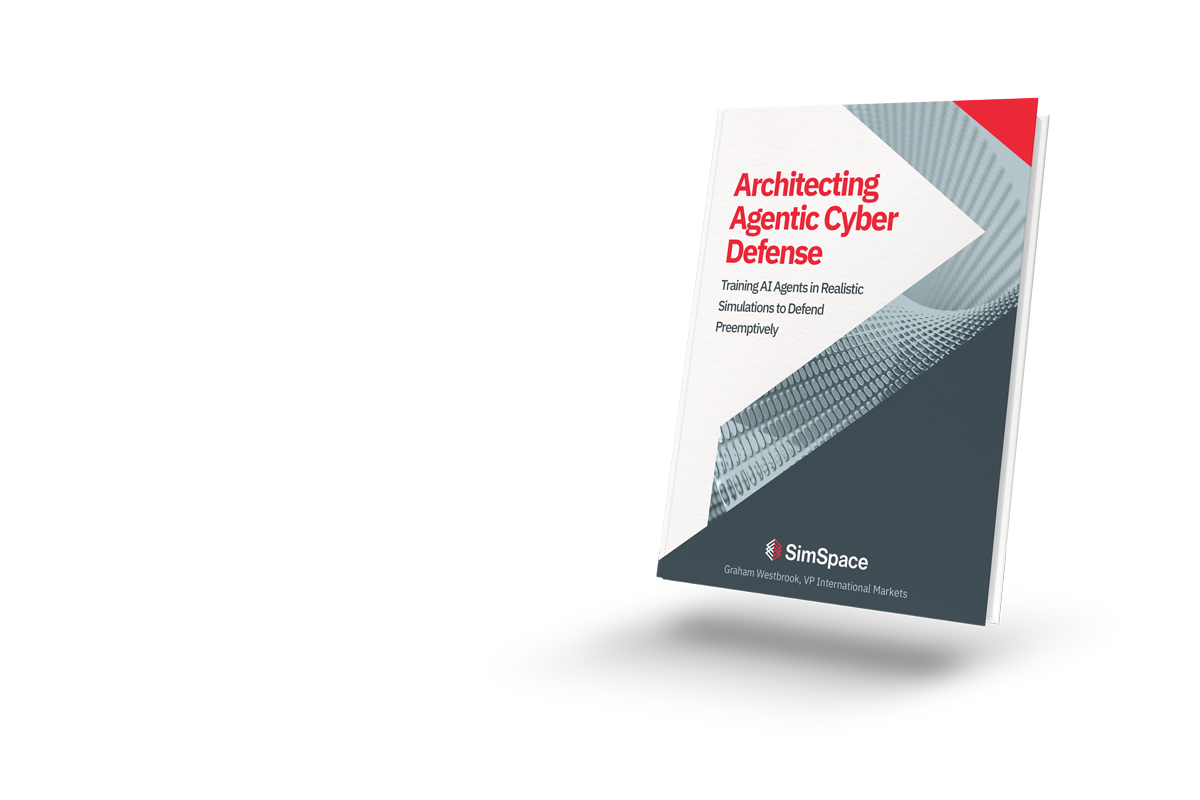
Training AI Agents in Realistic Simulations to Defend Preemptively
The shift from reactive response to preemptive cyber defense is already underway. The organizations that win will be those that train AI agents in realistic cyber environments before pushing decisions into production.
Inside, You’ll Learn:
Graham Westbrook, VP of International Markets at SimSpace, outlines a new architecture for agentic cyber defense—combining reinforcement learning, synthetic data, cyber range environments, and human oversight to optimize defenses before adversaries strike.
What “Preemptive” Cyber Defense Really Means
Moving beyond proactive and predictive toward autonomous defensive action before threat impact.
How to Architect AI Agent Training Safely
A five-layer model combining realistic environment simulation, monitoring tools, synthetic data, AI frameworks, and reinforcement learning models.
Why Cyber Ranges are Foundational to Trusted AI
Training and validating agents in realistic, non-production environments to avoid unintended consequences.
How CISOs Retain Control and Explainability
Keeping humans in the loop while accelerating optimization and reducing risk.
The Economic Case for Agentic Defense
Reducing false positives, consolidating tooling, avoiding breaches, and accelerating ROI.
Testing That Reflects Reality
Real attackers do not operate in clean lab environments, and readiness cannot be validated there either. This ebook makes the case for testing security capabilities under conditions that mirror real operations, including production-like infrastructure, realistic user activity, and adversary behavior that evolves under pressure. The goal is not theoretical confidence, but clear insight into what holds up, what degrades, and where gaps emerge before they are exposed in the real world.
Scroll to Top
SimSpace Named a Leader in the 2026 Forrester Wave™