
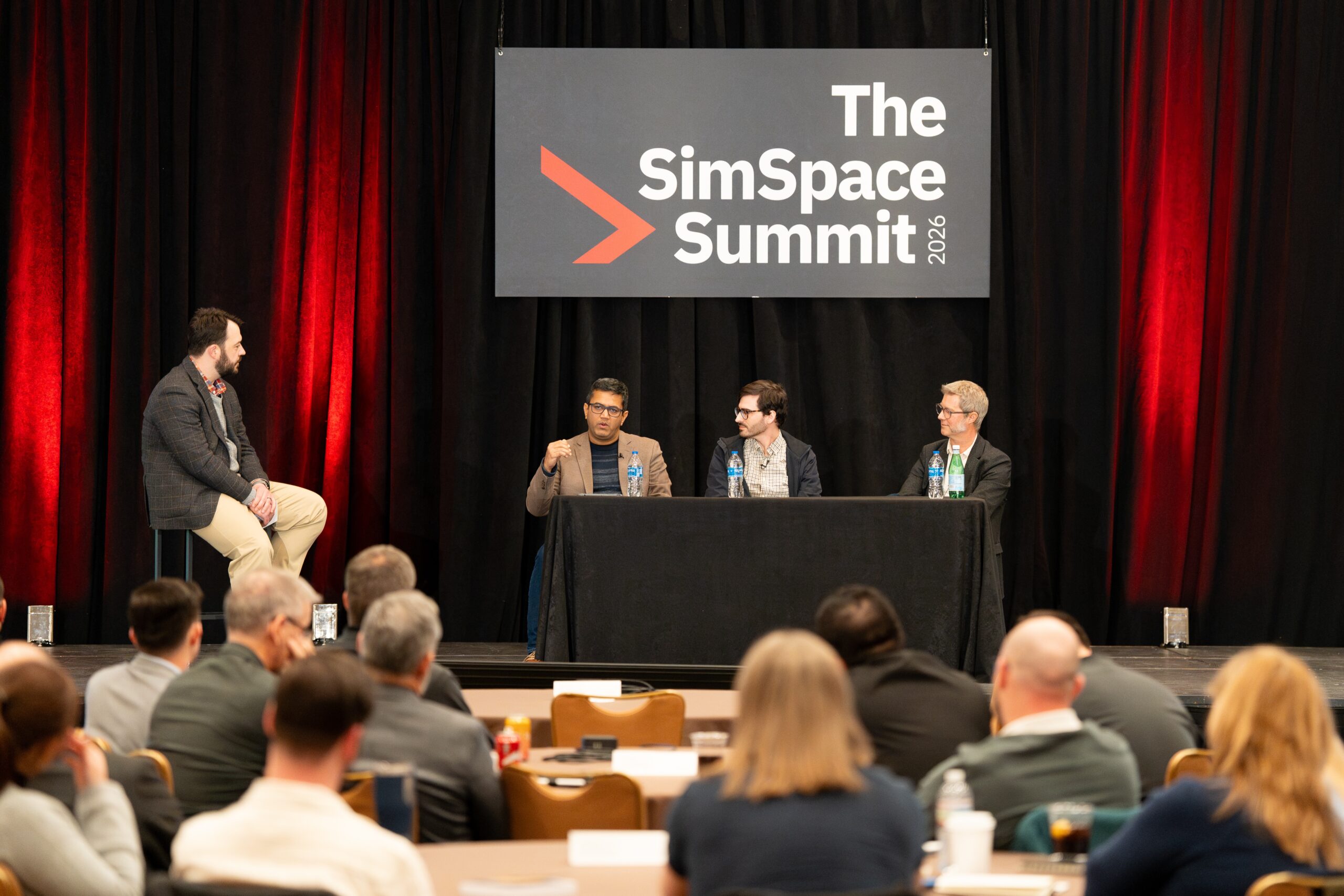
Key Takeaways from the SimSpace Summit OT Threat & Defense Testing and Research Panel
The SimSpace Summit recently brought together people who spend their days dealing with cyber defense in the real world. Government decision-makers, enterprise CISOs, and security researchers all sat down to discuss where things are heading.
We welcomed to the OT Threat & Defense Testing and Research panel Samir Kani, OT Lead at Kroll, David Formby, Co-Founder of Fortiphyd Logic, and our own Lee Rossey, CTO of SimSpace. The discussion started with a few myths that still shape how people think about OT security.
Misconception 1: OT Just Means Critical Infrastructure
Most people hear “OT” and picture power plants or dams. Those systems are part of it, but the scope is much wider.
OT shows up anywhere automation controls physical equipment. Water treatment facilities rely on it. So do oil pipelines, shipping ports, and manufacturing plants. Military platforms depend on it as well; a naval ship runs like a floating power plant. The systems that keep the world moving and powered fall into the OT category.
Large public events also rely heavily on OT. Stadiums are a good example; a major NFL game pulls in huge crowds and global attention, which means security agencies watch those events closely. The same will happen when the United States hosts the FIFA World Cup and the Olympics. Stadium operations, broadcasting systems, and facility controls all run on automated infrastructure.
Even something that sounds minor, like air conditioning in a stadium, becomes critical when tens of thousands of people are inside. If the system fails during a packed event, safety quickly becomes a concern. For the hours that the event is happening, the building operates like critical infrastructure.
Misconception 2: Attackers Won’t Bother With OT
When many OT systems were designed, security was not the main concern. Engineers focused on reliability and safety. Cyber attacks did not feel like an obvious risk at the time.
That assumption no longer holds. Nation-state groups now target these systems. They look at energy providers, manufacturing plants, ports, and other automated operations.
Smaller organizations face the toughest situation. Many of them fall under the same broad category of critical infrastructure but lack the resources of a large utility or government agency. They do not have large security teams, and budgets are tight, with the IT and operations teams competing for the same resources.
The semiconductor industry offers a clear example. Many people think of chip manufacturing as high-tech, but the factories rely on large, automated systems. In 2022, ransomware attacks hit several semiconductor companies, and manufacturing stopped for months while systems recovered. The disruption spread through the supply chain. Since then, attackers linked to the Chinese government have continued to probe the industry.
Misconception 3: OT Security Works Like IT Security
OT security and IT security share some tools, but the goals differ. IT security deals with information: servers, laptops, and databases hold data measured in bits and bytes.
OT security deals with physical systems: pumps, valves, turbines, robotic arms, or transportation controls that depend on software to function. A successful cyber attack in these environments can damage equipment or injure people.
Researchers working on OT security often talk about protecting physics; if a system controls temperature, pressure, electricity, or motion, the attack surface includes those physical effects.
Misconception 4: OT Systems Are Too Old to Patch
The idea that OT systems cannot be patched often comes up in security discussions. In reality, updates are possible. They just require more care.
Operators need to understand how a patch will affect the surrounding systems. Many OT environments run continuously, and a bad update can shut down production or disrupt safety controls.
Testing solves most of that risk. A simulated environment that mirrors the real network allows teams to try patches before rolling them out. The same approach helps security teams test new monitoring tools and run incident response exercises.
Security teams sometimes treat those environments as practice ranges. They test how their SOC responds to alerts and evaluate tools before purchasing.
Misconception 5: OT Is Not Ready For AI
AI is already entering OT environments, even if adoption moves slowly.
Many OT networks produce very predictable traffic patterns. Consider a naval ship: its systems exchange data in regular, well-understood patterns. If something unusual appears in the traffic, it stands out immediately.
AI models trained on those normal patterns can detect anomalies quickly. Because the environment is tightly defined, the system generates fewer irrelevant alerts than a typical enterprise network.
Remote locations make this capability even more valuable. A ship at sea cannot bring in outside specialists during an incident. Automated analysis helps the onboard crew respond faster.
The next wave of AI adoption will show up in robotics and manufacturing. As factories introduce AI-driven robots and automated production systems, security teams will need to understand the risks those systems introduce.
OT tends to move carefully when adopting new technology. Systems must prove themselves before operators trust them. Cyber ranges give teams a place to test AI tools and understand how they behave before introducing them into live operations.
To learn more about the power of realistic security testing for OT and critical infrastructure, schedule a demo with an expert at SimSpace.